The Workplace Hazardous Materials Information System (WHMIS) is Canada's national standard for communicating information about hazardous products in the workplace. It merges with the Globally Harmonized System of Classification and Labelling of Chemicals (GHS) to provide consistent classifications. Understanding WHMIS symbols is crucial for both employees and employers to recognize and handle potentially dangerous substances safely.
Understanding WHMIS Symbols
Overview of WHMIS Pictograms
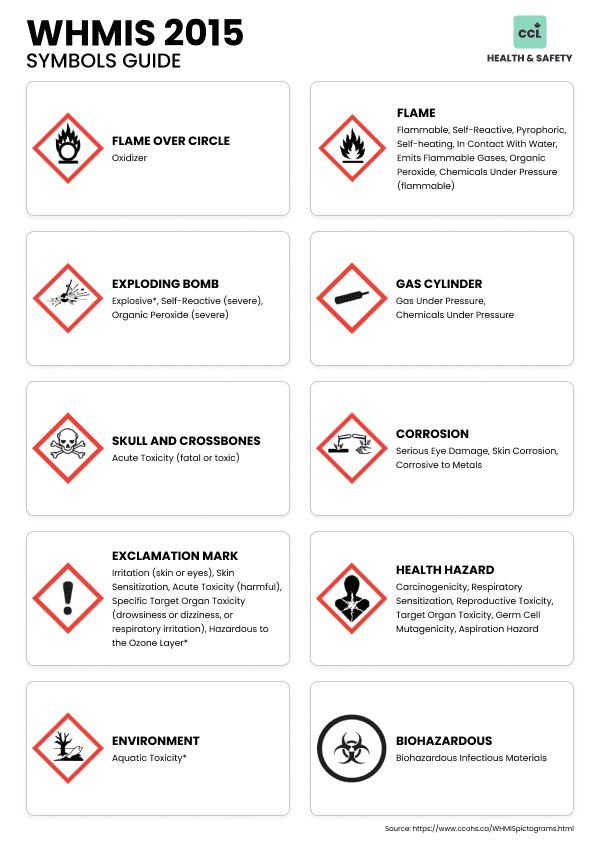
WHMIS pictograms are standardized graphics on a white background within a red diamond-shaped border. They are designed to provide at-a-glance information about the dangers presented by a hazardous chemical, supporting safer storage, handling, and use.
Health Hazard Symbols
Several WHMIS pictograms communicate health risks:
- Health Hazard: A figure with a starburst design indicating potential chronic health risks such as carcinogenicity or respiratory sensitization.
- Biohazardous Infectious Materials: Used for substances that contain organisms or toxins capable of causing infection or disease.
- Exclamation Mark: Indicates acute toxicity or other less severe hazards such as skin or eye irritation.
Physical Hazard Symbols
Physical hazard pictograms identify products that pose risks based on their physical properties:
- Exploding Bomb: Used for explosives, self-reactive substances, and organic peroxides.
- Flame: Used for flammable gases, liquids, solids, and self-heating chemicals.
- Gas Cylinder: Used for chemicals stored under pressure.
WHMIS Aligned with GHS
Alignment with GHS means WHMIS pictograms are now harmonized internationally. Workers can recognize hazards regardless of language or background through universal symbols, making it easier to operate across borders and supply chains.
Compliance and Regulatory Information
Federal and Provincial Legislation
WHMIS is administered at both federal and provincial levels. Federally, it is governed by the Hazardous Products Act and the Hazardous Products Regulations. Each province may layer on additional occupational health and safety legislation that affects how WHMIS is implemented in workplaces. The same dual-jurisdiction logic applies to other high-risk programs: see how we approach the provincial and federal frameworks in our confined space and lockout/tagout program development pages.
Hazardous Products Regulations
Manufacturers and suppliers must accurately classify the physical and health hazards of their products in line with GHS criteria. This drives mandatory labelling on containers and the provision of Safety Data Sheets (SDSs) to workplaces.
Safety Data Sheets Compliance
SDSs must be provided by the supplier and made available in the workplace for every hazardous product. They include details on substance properties, health and safety hazards, protective measures, and safety precautions, and must be reviewed and updated as required.
Best Practices for Workplace Safety
Safe Handling Procedures
Employees must understand how to interpret SDSs. Key SDS components include:
- Identification of the product and supplier.
- Hazard Identification and classification.
- Composition and information on ingredients.
- First-Aid Measures.
Workers should use appropriate PPE, follow storage guidelines, segregate incompatible substances, and dispose of hazardous waste according to applicable regulations.
Emergency Response and Precautions
A clear emergency response plan should cover immediate steps for spills, the location of emergency equipment, evacuation procedures, measures for different exposures, and contact information for emergency responders. Regular drills and refresher training keep these plans actionable.
Resources and Further Learning
Training and Education
Employers must provide WHMIS training so that employees can recognize symbols and apply safe handling procedures. Training typically covers categorization of chemicals and interpretation of SDSs, and is delivered through online courses, in-person workshops, and seminars. To check how the broader due diligence picture is holding up at your workplace, the free Ontario due diligence self-assessment walks you through the court's nine measures in about five minutes.
Supplemental Materials
Fact sheets and posters work well as quick references near workstations and storage areas. Update these materials regularly as WHMIS guidelines and product classifications evolve.
Need Health and Safety Help?
Get in touch with us today. Contact CCL Health & Safety to discuss WHMIS training and program support tailored to your workplace.
Ready to Strengthen Your Safety Program?
Our team specializes in building health and safety programs around Ontario's regulations for Ontario businesses.
Contact Us